
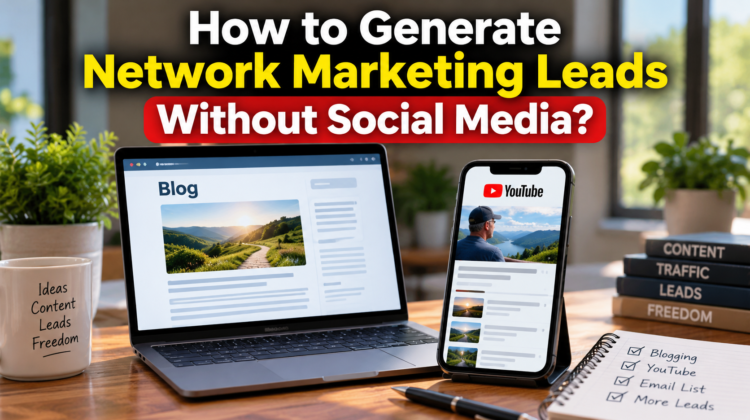
How do I generate network marketing leads without social media? My two favorite strategies to consider are blogging and search-based YouTube videos. Both let you reach people who are already looking for answers about network marketing, working from home, or building an online business. And unlike a post that quickly disappears down a social media feed, a useful article or video can continue attracting visitors long after you publish it.
That doesn’t mean either strategy produces instant leads. You still need to learn how to choose topics, create helpful content, and turn interested visitors into subscribers. But if you’re tired of feeling like you have to post every day just to stay visible, I think they’re worth a serious look.
Why I Prefer Search Traffic Over Chasing Social Media Feeds
I’ve been involved in online marketing since 2002, and one of the biggest lessons I’ve learned is that how someone finds you matters.
Think about the difference between someone scrolling through a feed and someone typing a question into Google or YouTube.
The person scrolling might be interested in your post. But they weren’t necessarily looking for a business, a product, or a solution to a marketing problem. You interrupted whatever they were doing.
Someone searching for “how to get leads for network marketing” is different. They’re telling you what they want help with. If your article or video answers that question, you’ve met them at a moment when they’re actively looking for information.
That doesn’t automatically make every search visitor a buyer. But in my opinion, targeting specific search questions gives you a better chance of attracting people whose interests match what you offer.
1. Blogging: Build Articles That Can Keep Working for You
A blog is one of the simplest ways to create content that people can discover through search engines. You write an article answering a question your ideal prospect is already asking, publish it on your website, and give it a chance to earn visibility over time.
For example, a network marketer might search for:
- How do I get network marketing leads without bothering friends and family?
- Why am I failing in network marketing?
- How can I recruit people into network marketing online?
- Why am I getting leads but no signups?
- How do I follow up with network marketing prospects?
Each of those questions could become a useful article. The key is to answer it honestly, explain what you’ve learned, and help the reader take a practical next step.
Why Blog Traffic Can Be Valuable
When someone lands on an article because it matches a problem they’re trying to solve, you already know something about their interests.
If they’re reading about getting network marketing leads, for example, they may be interested in learning how to generate traffic, build a capture page, or follow up with prospects. That’s a much more useful starting point than trying to convince a random stranger to look at your opportunity.
There’s another advantage I really like: an article doesn’t have to stop working when you stop writing.
Once a page earns search visibility, it may continue bringing visitors for months or years. Rankings can change, competition can increase, and some articles will never rank well. Still, the possibility of building something that keeps attracting visitors is a big part of the appeal.
The Downside of Blogging
Blogging is not a magic traffic machine. New websites can take time to establish visibility, and publishing an article doesn’t guarantee Google will send visitors to it.
You’ll need to choose questions people actually search for, write content that deserves to be found, and occasionally improve older articles. But the work has a different purpose than feeding a daily social media schedule: you’re trying to build a library of useful answers that can keep being discovered.
2. YouTube: Answer Questions People Are Already Searching For
YouTube is another strategy I like for essentially the same reason. People go there looking for solutions.
Instead of making a video about whatever happens to be trending, you can build videos around questions your ideal prospect might type into the search bar.
For example:
- How do you get your first network marketing customer?
- What should you do when nobody joins your network marketing business?
- Can you build a network marketing business without cold messaging?
- How do you generate free leads for network marketing?
You don’t need a studio or a complicated production process to answer those questions. A straightforward video explaining the problem, sharing your experience, and offering a practical solution can be enough to get started.
And just like a blog post, a search-focused YouTube video has the potential to attract viewers long after the day you upload it.
Why I Like YouTube for Building Trust
There’s one advantage YouTube has that a written article doesn’t always provide: people can hear you explain something in your own voice.
For network marketing, where trust and credibility matter, that can be valuable. Someone who watches a helpful video gets a sense of how you think and whether you understand the problem they’re facing.
They can decide whether they want to hear more from you without being pressured into a sales conversation.
Of course, YouTube isn’t completely separate from social media. It has recommendations, subscriptions, and Shorts. But using YouTube as a search engine is a different strategy from relying on a constantly refreshed social feed. The focus is on creating answers people can find when they need them.
If your biggest frustration is constantly having to hunt for the next prospect, the more important question may not be which platform to use. It may be whether you have a repeatable way to attract interested people, capture their information, and follow up. That’s the part of marketing I’d want to understand before spending months creating content.
What My TikTok Experiment Taught Me About Lead Quality and Sustainability
I’ve tested the social media approach, too. In one TikTok experiment, I published roughly 300 videos over about three months and generated approximately 535 leads. But those leads produced only one sale.
I began questioning whether the strategy was a good fit after around 200 leads. From my years in marketing, though, I wanted to give it a more meaningful test, so I continued past 500 leads.
One thing became increasingly clear: I couldn’t see myself maintaining that pace of video creation indefinitely.
Now, I don’t believe that experience proves TikTok doesn’t work. Other marketers may get very different results, and my offer, messaging, follow-up, and audience all played a role in my outcome.
But it reinforced two questions I think every marketer should ask:
- Are the people I’m attracting genuinely interested in what I’m offering?
- Can I realistically keep using this strategy for the next several years?
Getting leads is important. Getting leads who are a good match for your offer is even more important. And a strategy that burns you out isn’t much of a long-term plan.
Does Social Media Really Require You to Post Forever?
Not literally. A strong social media following can keep producing referrals, conversations, and business even during quieter periods. Some posts also get rediscovered later.
But most feed-driven content has a relatively short period of high visibility. New posts replace older ones, and staying in front of people often requires continued activity.
That’s the tradeoff that bothers me.
You can spend months building an audience of followers and still feel pressure to publish constantly to keep the leads coming. With blogging and search-based YouTube, the goal is different: build a collection of content that can be found because it answers questions, not simply because you posted it today.
Neither approach is guaranteed to work. Search rankings and YouTube discovery can fluctuate, too. But I would rather invest my time in content that has a realistic chance of producing leads beyond its first few days.
How Do You Turn Blog Readers and YouTube Viewers Into Leads?
Here’s where a lot of people miss an important step.
Traffic is not the same thing as leads.
Someone reading your article or watching your video is a visitor. They become a lead when they voluntarily give you a way to contact them, usually by joining your email list.
I’ve used email marketing for much of my online career, and I still believe building a list is one of the most valuable things you can do.
A basic lead-generation system doesn’t need to be complicated:
- Helpful content: Publish an article or video that answers a specific question.
- A relevant next step: Offer something useful related to that problem, such as a guide, training, or practical resource.
- A capture page: Give interested visitors a simple way to request it.
- An autoresponder: Deliver the resource and follow up by email.
- A relevant offer: When appropriate, show people how your product, service, or business might help them.
That system matters because most people won’t make a decision the first time they discover you. Some are just researching. Others need more information or time to decide whether you’re someone they want to work with.
An email list lets you continue the conversation without depending entirely on whether an algorithm shows them your next post.
Which Is Better for Network Marketing Leads: Blogging or YouTube?
I don’t think there’s one answer for everybody.
If you enjoy writing, explaining things in detail, and organizing information, blogging may be a natural fit. It also gives you a website you control, although your traffic still depends partly on search engines.
If you’re more comfortable talking than writing, YouTube may be easier to stick with. Viewers also get to know you through your voice and personality.
And if you eventually use both, one question can become an article and a video. You’re not necessarily doubling your research. You’re giving people two ways to find the same helpful answer.
But I wouldn’t recommend that a beginner launch a blog, YouTube channel, podcast, and three social media accounts at the same time.
Pick one primary strategy and learn how to make it work. Consistency with one manageable method is better than spreading yourself across five platforms and getting nowhere.
There’s also a practical consideration: learning to write articles or record videos is only one part of the job. You still need to know how to connect that content to a capture page, an email follow-up sequence, and a useful offer. Getting those pieces working together is what turns content creation into an actual lead-generation process.
A Simple 90-Day Plan to Start Generating Leads Without Social Media
If I were starting from scratch, I’d keep the first 90 days pretty simple.
First 30 Days: Choose Your Audience and Questions
Decide who you want to help. For example, you might focus on network marketers who are struggling to recruit, people who don’t want to approach friends and family, or distributors who have leads but aren’t making sales.
Then write down the questions those people are likely to search for. Choose one platform—blogging or YouTube—and start publishing genuinely useful answers.
Days 31–60: Connect Your Content to a Lead-Capture System
Make sure visitors have a relevant reason to join your email list. If your article is about finding prospects, don’t send readers to an unrelated offer. Give them a next step that helps with the problem they came to solve.
Set up a straightforward follow-up sequence that introduces you, delivers value, and gives interested people a chance to learn more.
Days 61–90: Improve What You’re Doing
Look at which questions attract visitors or viewers, which content gets people to your capture page, and whether subscribers are responding to your follow-up.
Don’t judge the entire strategy solely by how much money you’ve made in 90 days. Especially with search traffic, early results can be modest. Use that period to develop a publishing routine, test your message, and make sure the basic system works.
Then keep improving it.
Can You Really Generate Network Marketing Leads Without Social Media?
Absolutely. People generated leads long before today’s social platforms existed, and search-based content gives you another way to reach people without spending your days chasing a feed.
For me, the biggest attraction of blogging and YouTube is the possibility of building long-term marketing assets.
An article you write today might help someone six months from now. A video you record this week might answer a question for someone who doesn’t discover you until next year. There’s no guarantee either one will rank or keep generating traffic, but the potential is there.
And that changes how I think about the work.
Instead of asking, “What do I have to post today to get somebody’s attention?” I’d rather ask, “What useful answer can I create today that people may still be searching for years from now?”
If you’re tired of social media but still want to build your network marketing business, you don’t necessarily need a new opportunity. You may simply need a different way to attract the right people—and a system for staying in touch once they find you.
And if you’d like to see how the pieces of that system fit together—from attracting visitors to collecting leads and following up—there’s a practical next step below that can help you evaluate what you’re missing.
Leave a Reply