
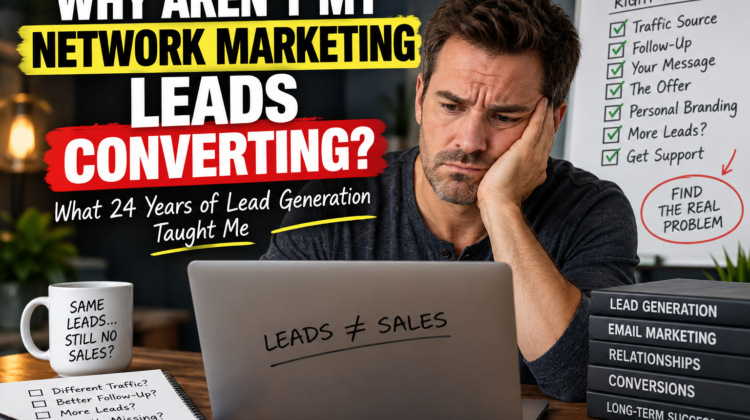
You’re generating leads.
People are entering their names and email addresses.
Maybe you’re even generating leads every single day.
There’s just one problem.
Nobody is joining.
Or at least not enough people are joining to make you feel like all the work you’re putting into lead generation is actually paying off.
If you’re in that situation, it’s tempting to immediately conclude that your leads are bad.
Sometimes they are.
But after more than 24 years of generating leads online, I’ve learned that there are a lot of places between generating a lead and making a sale where things can break down.
I’ve generated leads using everything from bulk email in the early 2000s to safelists, email marketing, social media, TikTok, and other online strategies.
Some of those leads converted extremely well.
Some converted terribly.
In one of my more recent experiments, I generated 535 leads from more than 300 TikTok videos and made one sale.
So believe me, I know what it feels like to stare at a pile of leads and wonder:
Why the heck aren’t these people buying?
The answer isn’t always obvious.
But there is a process I would use to figure it out.
Start With the Most Important Question: Where Are Your Leads Coming From?
If someone told me they were generating leads consistently but nobody was joining their business, my first question would be:
Where are the leads coming from?
Before changing your emails, rewriting your sales page, switching companies, or deciding that you’re terrible at network marketing, figure out what kind of people are actually entering your funnel.
There can be an enormous difference between someone who actively searched Google or YouTube for information about starting a network marketing business and someone who clicked an ad while scrolling through social media.
There can also be a big difference between a lead you generated through your own content and a lead you purchased from someone else.
And then there are traffic sources where people may technically be interested in making money online but are being exposed to dozens or even hundreds of other opportunities.
Those are all “leads.”
But they aren’t necessarily the same quality of lead.
I learned that lesson firsthand with TikTok.
I generated 535 leads, which sounds pretty good until you look at what happened afterward.
My email open rates were under 5%, there were very few clicks, and ultimately those 535 leads produced one sale.
That told me something.
The problem wasn’t simply that I needed a better closing technique.
The lack of engagement was happening much earlier in the process.
That’s why I wouldn’t diagnose a conversion problem without first understanding where the leads came from and what caused them to become a lead in the first place.
What Happens After Someone Becomes a Lead?
The next thing I would want to know is:
Where are you sending them?
This is an area where I think a lot of network marketers give up control of the process too quickly.
Someone opts in and immediately gets dumped onto the company’s replicated website.
Now what?
They see the company.
They see the products.
They see the compensation plan.
They might see some corporate videos.
But what makes you different from the other 10,000 distributors who can send someone to exactly the same website?
One of the most important changes I made fairly early in my online career was building my own email list.
Instead of sending my traffic directly to the network marketing company, I captured the lead into my own autoresponder first.
That allowed me to follow up with those people myself.
It also meant I owned the relationship with that prospect rather than handing the entire relationship over to the company.
That distinction became incredibly important to my business over the years.
Look at Your Open Rates and Click Rates
If you’re capturing your own leads and following up through email, you now have some numbers that can help diagnose the problem.
Start with your open rate.
Are people actually opening your emails?
If they aren’t, you may have a traffic-quality problem, a deliverability problem, or simply an audience that isn’t particularly interested in what you’re sending them.
If they are opening your emails, look at your click rate.
Are they clicking to learn more?
This starts narrowing down where the problem is occurring.
Think of it as a funnel.
If people aren’t opening, the breakdown is happening near the top.
If they’re opening but aren’t clicking, something between the subject line and the call to action isn’t moving enough people to the next step.
If they’re opening, clicking, watching your videos, looking at the opportunity, and still not buying, now we need to look farther down the funnel.
Instead of saying, “My leads aren’t converting,” try to figure out where they stop converting.
That is a much more useful question.
If you want the right tools, training and live help to get better conversions, I recommend clicking the banner below.
Make Sure the Offer Actually Converts
At some point you have to consider another possibility.
Maybe the offer just isn’t very compelling.
But there’s a relatively simple question I would ask before reaching that conclusion:
Are other people successfully building the same company?
Are people consistently recruiting?
Are people building substantial teams?
If the answer is yes, then you have evidence that the offer can convert.
That doesn’t mean every person will get the same results. It also doesn’t mean the company is necessarily the right fit for you.
But it does tell you something important:
Other people are successfully presenting essentially the same underlying opportunity.
At that point, rather than immediately blaming the company, I would start looking at how you’re positioning yourself and how you’re communicating with your leads.
And this is where personal branding becomes incredibly important.
People Join People More Than They Join Companies
If you’re brand new to network marketing, you may be thinking:
“That sounds great, Nate, but what am I supposed to brand? I haven’t accomplished anything yet.”
I understand.
When I started in 2002, I didn’t have an online success story.
I was making $928 a month on disability and a few hundred dollars more working part-time overnight at a department store.
I wasn’t some internet marketing guru.
You don’t need to pretend you’ve accomplished something you haven’t.
In fact, I think that would hurt you more than help you.
Instead, share your story.
Share why you’re building the business.
Share what you’re learning.
Share your goals.
Share your journey.
If you have personal experience with the products, talk about that. If other people have legitimate product experiences or testimonials that you’re permitted to share, those can help too.
And if you haven’t achieved the success you want yet, share the plan you’re following to get there.
I think people are naturally attracted to people who have either accomplished something they want to accomplish or who clearly have a plan for where they’re going.
You don’t have to position yourself as an expert when you’re not one.
You can simply let people get to know who you are.
Because ultimately, people join people more than they join companies.
Stop Expecting Every Lead to Buy Immediately
This has become even more important over the years.
It seems to me that people generally take longer to make buying decisions today than they did 15 or 20 years ago.
Depending on the offer and how well it converts overall, you can absolutely make sales or recruit people on their first exposure.
It happens.
But I wouldn’t build my entire marketing strategy around expecting it.
More often, people need multiple exposures.
They may need several emails.
They may watch several videos.
They may follow you for weeks.
Sometimes months.
I’ve even seen people finally buy a year or two after originally becoming a lead.
That’s one of the biggest reasons I’m such a believer in building your own email list.
A lead who doesn’t buy today isn’t necessarily a bad lead.
They may simply not be ready today.
If you’re sending people directly to a replicated company website and never capturing their information, someone who isn’t ready today may disappear forever.
If they’re on your email list, you have the opportunity to continue the relationship.
Fifty Leads Probably Isn’t Enough to Tell You Much
Another mistake I see is drawing conclusions from tiny numbers.
Someone generates 50 leads, doesn’t make a sale and decides:
“This doesn’t work.”
Maybe it doesn’t.
But 50 leads wouldn’t be enough for me to make that determination, especially if you’re relying primarily on email follow-up.
Personally, when I’ve tested purchased traffic or other straightforward lead sources, I generally like to see something more in the neighborhood of 300 to 500 leads before making a serious judgment.
That isn’t some scientifically perfect number.
It’s simply the range I’ve been more comfortable using based on my own experience.
And you don’t have to blindly keep buying leads until you hit 500 if everything else is screaming that the traffic is terrible.
If nobody opens your emails, nobody clicks anything, and nobody responds, those are signals too.
The point is that you need enough data to make a reasonable decision.
Five leads isn’t data.
Twenty leads isn’t much better.
Even 50 leads can produce a misleading result.
Network marketing is still a numbers game.
And some offers simply require more prospects than others.
Sometimes Your Leads Aren’t Failing—You Just Need More of Them
This is another uncomfortable possibility.
You may tell me:
“I generate leads consistently.”
Great.
How many?
If the answer is one or two per day, that may be a perfectly good start.
But it may not be enough to produce the number of sales or recruits you’re expecting.
Let’s say your particular combination of traffic, follow-up, relationship building and offer eventually produces one customer or distributor for every 100 leads.
Generating one lead a day means it could take months to generate enough volume for the math to start working in your favor.
That doesn’t necessarily mean anything is broken.
It may simply mean you need more volume.
This is one reason I spent so much time early in my career focusing on lead generation.
I wasn’t trying to become the world’s greatest salesperson.
I wanted enough qualified people continually entering my funnel that I didn’t have to convince every person to join.
If You Need Results Faster, Get More Personal
When I started my first network marketing business in 2002, getting started cost me around $300.
At the time, I was receiving $928 a month in disability income and making a few hundred dollars extra from my part-time overnight job.
That $300 was almost as much as my mortgage payment.
So my mindset wasn’t:
“How can I automate this entire thing and work four hours a week?”
I needed to make money.
I focused heavily on generating leads, but I also picked up the phone.
I made outgoing calls.
When I talked to somebody who sounded genuinely interested, I put them on what I called my A-list.
If we had an upcoming webinar, I might call that person the day before or even the day of the webinar to remind them.
Then I’d follow up afterward.
If they missed the webinar but still sounded interested, I’d keep them on my list and invite them to the next one.
There were prospects I talked to three, four or even five times over the course of a week, two weeks or a month.
I kept adding interested people to that list and removing people who stopped responding or clearly weren’t interested.
Was it automated?
Nope.
But at that point in my life, automation wasn’t my highest priority.
Income was.
Your Situation Should Determine How Much You Automate
Today, I look at this a little differently.
If you desperately need income and you’re willing to put in the time, being proactive with your leads can make sense.
Call people.
Have conversations.
Follow up with your most interested prospects.
Today you could also use social media messaging and other forms of direct communication that weren’t available to me in 2002.
But maybe you’re in a different position.
Maybe you have an income already and you’re intentionally trying to build what I like to call a freedom business.
In that case, you may choose to rely more heavily on automation.
Neither approach is automatically right or wrong.
You just have to understand the tradeoff.
If you’re removing yourself from the personal follow-up process, you need to get better at creating an automated system that builds the relationship for you.
And one of the most powerful tools I’ve found for doing that is video.
Video May Be the Best Replacement for a Phone Call
An email lets somebody read your words.
Video lets them see you.
They can hear your voice.
They can get a sense of your personality.
They can hear your story.
They begin to understand what you’re about.
It’s still not exactly the same as having a one-on-one conversation, but I think it’s pretty darn close.
And video has one enormous advantage over phone calls.
You can communicate with 10, 50 or 100 people at the same time.
You can even be communicating with them while you’re doing something completely different.
That’s leverage.
A video you record once can continue introducing you to prospects again and again.
So if someone told me they wanted to build a highly automated network marketing business without spending every evening calling prospects, I would strongly consider incorporating video into the follow-up process.
It allows you to automate without becoming invisible.
Don’t Turn Every Email Into a Pitch
I’ve never considered myself some slick salesperson.
I’m not the guy who wants to spend two hours on a webinar using every persuasion technique known to mankind.
That’s never really been my strength.
What I have learned from my own marketing is that I don’t want every communication with my list to be:
Buy this.
Join this.
Here’s another opportunity.
Did you join yet?
People tune that out.
Provide value.
Help people solve problems.
Share things you’ve learned.
Tell stories.
Let people follow your journey.
And yes, make offers.
You’re running a business.
There’s nothing wrong with asking someone to look at what you’re selling.
But if every interaction exists solely to extract a sale, it’s difficult to build much of a relationship.
I would much rather have someone stay on my email list, learn from me, get to know me and eventually decide that something I’m recommending makes sense for them.
Sometimes that takes longer.
That’s okay.
Don’t Confuse a Conversion Problem With a Follow-Up Problem
This distinction is important.
Imagine two marketers each generate 500 leads.
The first sends every lead directly to a replicated website.
Most people leave and are never heard from again.
The second captures those 500 people into an autoresponder, introduces themselves through video, provides useful information, sends regular emails and continues following up for months.
Technically, both marketers generated 500 leads.
But they didn’t really create the same asset.
The second marketer created 500 opportunities to build a relationship over time.
That’s why I don’t think you can separate conversion from follow-up.
Your follow-up process is part of your conversion process.
When Everything Looks Right but Nobody Is Buying, Get Another Set of Eyes
Eventually you can reach a point where the obvious explanations don’t fit.
You’re generating targeted leads consistently.
You’re building your own list.
Your emails are getting opened.
People are clicking.
The company has a proven offer and other distributors are successfully recruiting.
You’re providing value and building relationships.
But you’re still not getting the conversions you think you should be getting.
At that point, I wouldn’t necessarily keep changing random things.
I would get help.
Find someone experienced who can look at your entire process.
Show them the traffic source.
Show them the capture page.
Show them the emails.
Show them the videos.
Show them where you’re sending people.
Show them the offer.
Sometimes you’re too close to your own business to see the problem.
A coach, mentor or experienced marketer may spot something in 10 minutes that you’ve been staring at for three months.
That’s one reason I’ve become such a believer in having access to live coaching and support rather than trying to figure out every part of online marketing by yourself.
Sometimes you don’t need another traffic source.
You need another set of eyes.
If you could use a more complete set of marketing tools along with practical training and ongoing support, you can take a closer look at that here.
If This Is What You Really Want, Keep Figuring It Out
There’s one more thing I would tell somebody who’s frustrated because their leads aren’t converting.
Ask yourself:
Is this something I really want to do?
Because if it is—and you’re enjoying the process enough to keep going—I don’t think a bad month, a failed traffic source or a lousy conversion rate should determine your future.
I’ve had strategies work incredibly well and eventually stop working.
I’ve generated hundreds of leads from strategies that produced almost nothing.
I’ve had leads buy almost immediately.
I’ve had people buy a year or two later.
The internet has changed.
Lead-generation strategies have changed.
The way people communicate has changed.
My own life has changed.
But the underlying process hasn’t changed nearly as much as people think.
Find people who have a problem or desire.
Get in front of them.
Give them a reason to raise their hand.
Build a relationship.
Make an offer that can help them.
Measure what happens.
Improve the parts that aren’t working.
And keep going.
If this is something you genuinely want to build, don’t interpret a conversion problem as proof that you can’t do it.
Figure out where the process is breaking.
Then fix that part.
I still believe strongly in network marketing and especially in the leverage and residual-income potential it can create.
If your leads aren’t converting the way you’d like, the next step is to take a closer look at the tools, follow-up process, and training behind your marketing. Having a system you can actually use—and support when you get stuck—can make it easier to identify what needs improving.
Leave a Reply